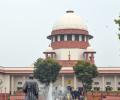
The Supreme Court is scheduled to hear on March 18 a plea seeking to debar from polls, candidates charged with serious offences. The plea, filed by advocate Ashwini Kumar Upadhyay, seeks directions to the Centre and the Election Commission of India (ECI) to restrain such candidates put on trial for serious offences. The plea alleges that despite recommendations of the Law Commission of India and court's previous directions, the Centre and the ECI did not act. The plea also highlights the increasing number of MPs with declared serious criminal cases since 2009, with one MP declaring 204 criminal cases against him, including culpable homicide, house trespass, robbery, criminal intimidation, etc. It claims that political parties are competing with each other in a race to the bottom as they couldn't afford to leave their competitors free to recruit persons with criminal antecedents.
The Supreme Court has stated that roads cannot be blocked for religious activities and that while religious denominations have autonomy in worship, the government can interfere if secular activities are affected.

Petitioner and advocate Ashwini Kumar Upadhyay submitted that a large amount of currency has reached either an individual's locker or has "been hoarded by separatists, terrorists, Maoists, drug smugglers, mining mafias and corrupt people".

The Supreme Court has directed the Election Commission to provide details regarding the 3.66 lakh voters excluded from Bihar's final electoral roll after a Special Intensive Revision (SIR) exercise. The court's direction came after concerns were raised by petitioners about the lack of notice or reasons given to the excluded voters.
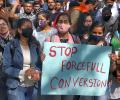
The Supreme Court on Friday sought response from the Centre and others on a plea seeking direction to take stringent steps to control fraudulent religious conversion by "intimidation" and through "gifts and monetary benefits".

Recently, the Madurai bench of the Madras high court has ordered that the probe into the girl suicide matter will be transferred to the CBI.

The Delhi high court on Wednesday asked the Centre and the Delhi government to present their stand on a plea seeking recall of all currency notes above Rs 100, restricting cash transactions above Rs 10,000 and linking assets worth more than Rs 50,000 with Aadhaar to check corruption.
The apex court perused the status report filed by the ministry of minority affairs which said meetings were held with the states on the issue.
The Centre said as a matter of judicial review, the court could declare the provisions to be unconstitutional, however, the relief sought by the petitioner effectively sought to read "life-long" instead of "six years" in all sub-sections of Section 8 of the Act.
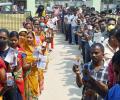
The Delhi high court on Friday refused to entertain a PIL seeking direction to the Centre and the Election Commission to make voting compulsory in parliamentary and assembly polls, saying it cannot force a person to vote.
The court had warned a "very difficult situation" will emerge if proselytisation through deception, allurement and intimidation is not stopped.
Forced religious conversion may pose a danger to national security and impinge on the religious freedom of citizens, the top court had said recently and asked the Centre to step in and make sincere efforts to tackle the "very serious" issue.
Terming forced religious conversion a "very serious" issue, the Supreme Court on Monday asked the Centre to step in and make sincere efforts to check the practice.
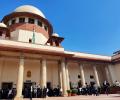
The Supreme Court Friday granted the 'last opportunity' to the Centre to file its reply on a public interest litigation seeking directions for framing of guidelines identifying minorities at the state level as Hindus are in a minority in 10 states and are not able to avail the benefits of schemes meant for minorities.

Additional solicitor general KM Nataraj, appearing for the Centre, told a bench of Justices SK Kaul and A Amanullah that responses were still awaited from Rajasthan and Telanagana.

A bench headed by Chief Justice D Y Chandrachud observed that candidates may contest elections from different seats due to a variety of reasons and it is Parliament's will as to whether the course of democracy would be furthered by granting such a choice.

The petition sought directions for taking steps to promote brotherhood and national integrity in the country.

Upadhyay, in his plea, challenged the validity of section 2(f) alleging that it gives unbridled power to the Centre terming it "manifestly arbitrary, irrational, and offending".
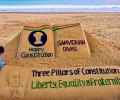
A bench comprising Justices Sanjiv Khanna and Sanjay Kumar passed the remark while hearing a batch of petitions filed by former Rajya Sabha MP Subramanian Swamy, advocate Vishnu Shankar Jain and others, who have challenged the inclusion of words "socialist" and "secular" in the Preamble of the Constitution.
The Supreme Court on Monday said it would hear on February 3 a batch of pleas challenging controversial state laws regulating religious conversions due to interfaith marriages.
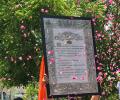
The Supreme Court on Friday observed the 1976 amendment to the Constitution adding terms 'socialist', 'secular' and 'integrity' to the Preamble underwent judicial reviews and it cannot say whatever Parliament did during the emergency period was all nullity.
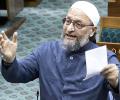
The Supreme Court on Thursday agreed to consider a plea of All India Majlis-e-Ittehadul Muslimeen (AIMIM) chief Asaduddin Owaisi seeking the implementation of the 1991 places of worship law, which asks to maintain the religious character of a place as it existed on August 15, 1947.
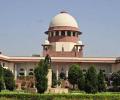
The SC directed the centre to place before it details regarding 1,581 cases involving MPs and MLAs, as declared by politicians at the time of filing their nominations during the 2014 general elections.

The Centre on Tuesday told the Supreme Court that it has held consultative meetings with all state governments, Union territories and other stakeholders on the issue of identification of minorities at the state level and 14 states have furnished their views so far.
The Centre told the Supreme Court on Monday that religious freedom does not include a fundamental right to convert other people to a particular religion and that it certainly does not embrace the right to convert an individual through fraud, deception, coercion or allurement.
The Supreme Court on Friday directed listing of pleas, which have raised the issue relating to the practice of political parties promising freebies, before a three-judge bench.

The Supreme Court on Tuesday sought the response of the National Human Rights Commission (NHRC), National Commission for Women (NCW) and the National Commission for Minorities (NCM) to pleas challenging the constitutional validity of polygamy and 'nikah halala' among Muslims.

The Reserve Bank of India (RBI) on Tuesday told the Delhi high court that withdrawal of Rs 2000 notes is not demonetisation but a statutory exercise, and the decision to enable their exchange was taken for operational convenience.
A bench comprising Chief Justice Sanjiv Khanna and Justice Sanjay Kumar also indicated that it may not take up the pending scheduled petitions, heard earlier by a three-judge bench, during the day as it was sitting in a combination of two judges.
A bench of Justices DY Chandrachud and JB Pardiwala said the petitioners will be able to supplement the grounds of challenge in the pending petitions.
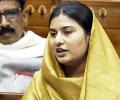
Samajwadi Party leader and Kairana MP Iqra Choudhary has moved the Supreme Court seeking effective implementation of the Places of Worship (Special Provisions) Act, 1991. This move comes amidst several petitions challenging the law's validity, including those filed by the Akhil Bhartiya Sant Samiti and lawyer Ashwini Upadhyay. The Supreme Court, in December 2022, had restrained all courts from examining fresh suits and passing interim orders in pending cases seeking to reclaim religious places. The Act aims to maintain the religious character of places of worship as they existed on August 15, 1947, but the dispute relating to Ram Janmabhoomi-Babri Masjid at Ayodhya was kept out of its purview. The court has listed Choudhary's plea with other pending pleas for February 17.
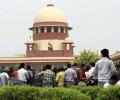
A bench of Justices R F Nariman, B R Gavai and Hrishikesh Roy told senior advocate Gopal Sankaranarayana, appearing for petitioner advocate Ashwini Upadhyay, "What kind of writ petition is this under Article 32. We will impose a heavy cost on you. You argue on your own risk."
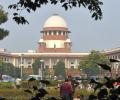
The top court said the secretary may collate necessary information by corresponding directly with the secretary of the home department of respective states and UTs within three weeks and compile it state-wise.
Commencing hearing on pleas challenging the constitutionality of the Places of Worship Act, 1991, the Supreme Court asked the Centre to reply to cross-pleas against or seeking implementation of statute.

The Election Commission (EC) must have the power to deregister a political party in case of a violation of the mandatory conditions for registration and for breach of laws, the Supreme Court was told by a petitioner on Monday.
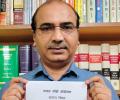
A Delhi court on Wednesday granted bail to former Bharatiya Janata Party spokesperson Ashwini Upadhyay, arrested in connection with the communal slogans allegedly raised during a protest at the Jantar Mantar in New Delhi.
The Supreme Court on Wednesday said there must be a "debate" on the "serious" issue relating to the practice of political parties promising freebies and asked why cannot the Centre call for an all-party meeting on it.
A bench of Justices SK Kaul and MM Sundresh said in a matter like this an affidavit is filed that Centre and state both have powers.
A video showing anti-Muslim slogans being raised during a protest at Jantar Mantar here was widely circulated on social media, following which the Delhi Police registered a case in connection with the matter on Monday.

The Centre pleaded in HC that it is waiting for responses from various states over UCC.
 © 2026 Rediff.com - Advertise with us - Disclaimer - Privacy Policy - Sitemap - Feedback - About us - Terms of use - Grievances